How many players who are not Dick McAuliffe, in all of major league baseball history, have made the All-Star team as a second baseman and a shortstop? None many. Zero. Just Dick.
This is another card that I remember when it still smelled of dusty pink bubblegum. It came in the bright red and yellow wax pack, with a color drawing of a pitcher or a batter or an obvious likeness of Oakland manager Dick Williams yelling at an umpire.
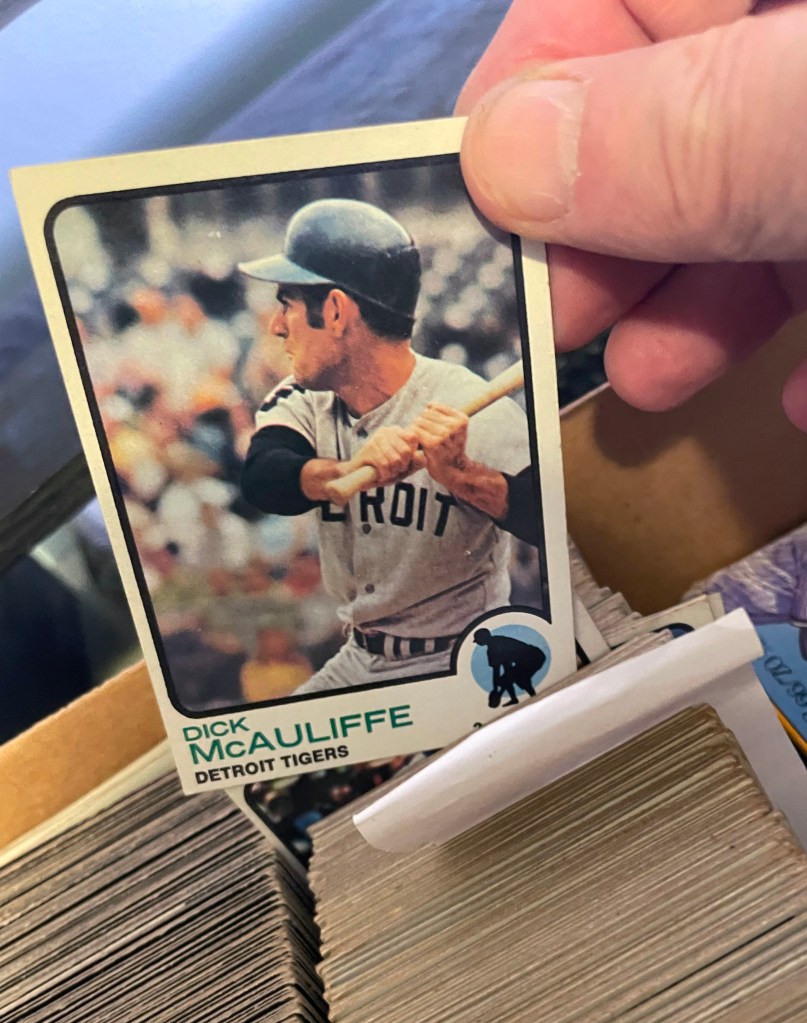
I’ve always loved this card, for a few reasons. The first is, in my hazy memory of a late 60s childhood, McAuliffe represented the prototypical everyman ballplayer. For some reason, I must have seen a lot of Tiger games on Saturday afternoons. His name is logged in my inner soundtrack, and he helped me make the transition from seeing baseball in black and white to color. Also, look at the photo! A great action closeup, taken from a cool angle – it perfectly captures McAuliffe’s odd batting stance. If you look at the back of his card, you’ll see where it notes that Dick’s stance is like Mel Ott’s.
But Dick, whose nickname was Mad Dog, was in a class by himself in the oddball batting stance club, whose membership includes some fine hitters, such as Bobby Tolan, Joe Morgan, Rod Carew, even Stan Musial, with his peek-around-the-corner posture, and Willie Stargell, with his windmill warmup before blasting baseballs into orbit. McAuliffe wasn’t in their class as a hitter, but author Bill James ranks him 22nd among second basement, all-time, in The New Bill James Historical Baseball Abstract (ahead of Hall of Famers like Johnny Evers, Red Schoendienst, and Bill Mazeroski).
James’ memory of Dick’s batting style is the best one I’ve read: “He tucked his right wrist under his chin and held his bat over his head, so it looked as if he were dodging the sword of Damocles in mid-descent. He pointed his left knee at the catcher and his right knee at the pitcher and spread the two as far apart as humanly possible, his right foot balanced on the toes, so that to have lowered his heel two inches would have pulled his knee inward by a foot. He whipped the bat in a sort of violent pinwheel which produced line drives, strikeouts, and fly balls, few ground balls and not a lot of pop outs.”
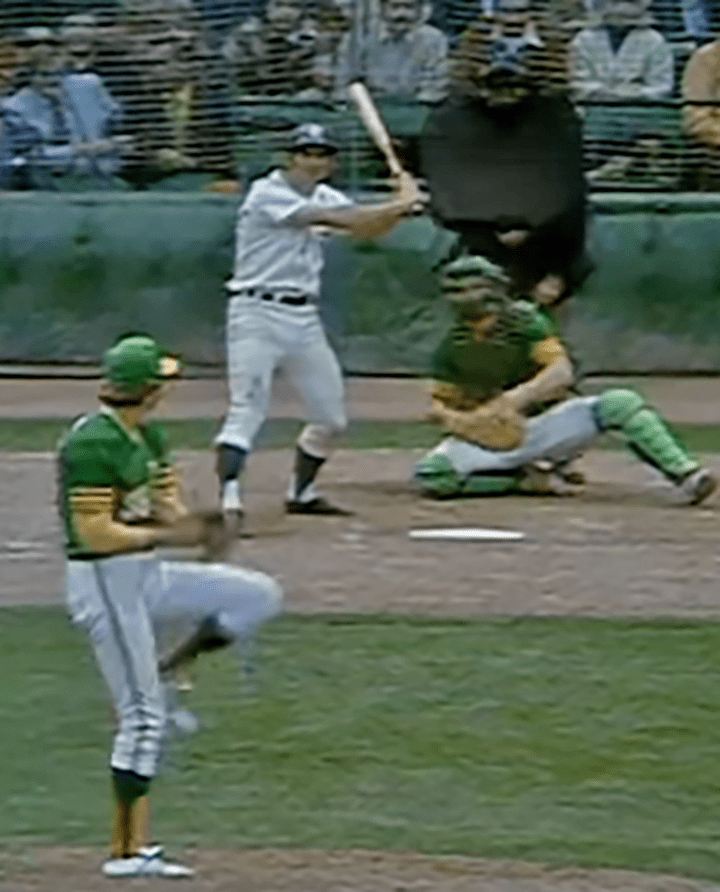
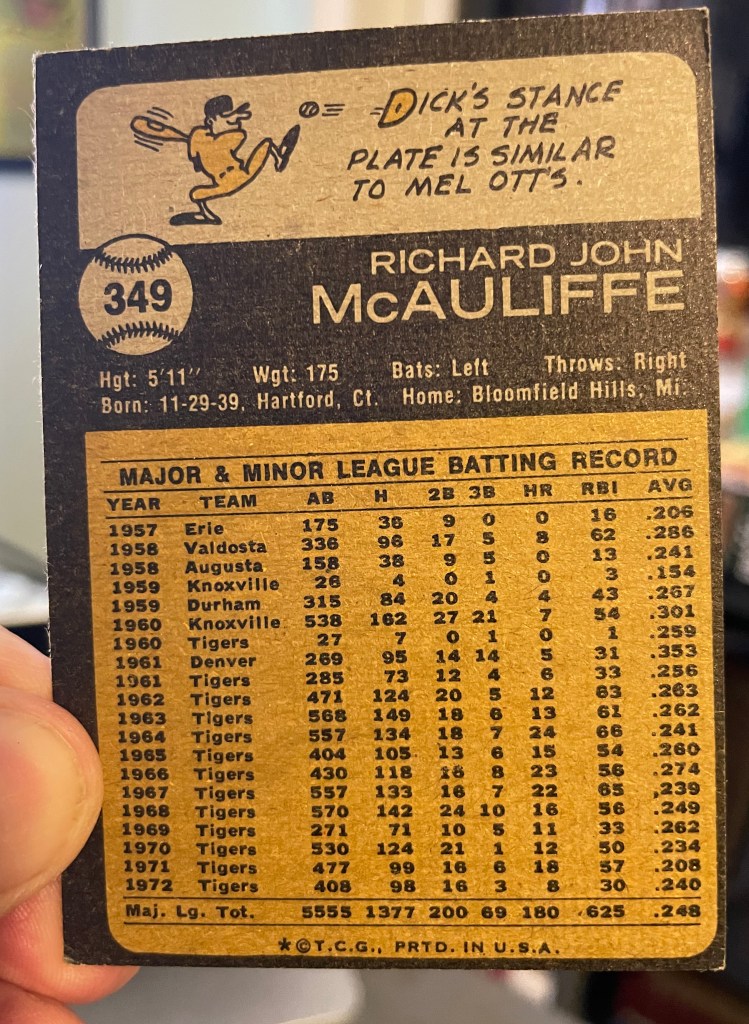
Bill described McAuliffe as, “functionally effective,” and some years he was better than that. He led the American League in runs scored in 1968 – the Year of the Pitcher, when Dick’s Detroit Tigers won a thrilling World Series over the St. Louis Cardinals.
He bashed 20 or more home runs three times, had a .509 slugging average one year. He had good power for a guy who choked up on the bat and was probably the best power-hitting second baseman of his time.
Though he was mainly a second baseman in his career, he was an American League All-Star at shortstop twice, and second base once. After Dick retired as a player in 1975, he was offered an opportunity to manage in the minor leagues, but didn’t have the steam for it.
Instead, he ran a couple of baseball schools. McAuliffe died in 2016 from complications of Alzheimer’s disease, but not before entering an entirely new career. Before retiring to play golf and enjoy some downtime, Dick McAuliffe became the best ex-second baseman in baseball history to own and operate a highly successful coin laundry repair company.
******
Johnny Mize P.S. Speaking of Bill James, the father of sabermetrics (or godfather or some kind of patriarch in that world), he ranks the Big Cat No. 6 all time among first basemen in the aforementioned classic abstract. Keeping in mind this is a 22-ish year old book, here are Bill’s top 10 rankings at the first sack, in order: Lou Gehrig, Jimmie Foxx, Mark McGwire, Jeff Bagwell, Eddie Murray, Johnny Mize, Harmon Killebrew, Hank Greenberg, Willie McCovey, Frank Thomas. I don’t know where he ranks modern superstars like Freddie Freeman and Paul Goldschmidt. So, the list has certainly changed. Anyway, you can read more about Mize in “Big Cat: The Life of Baseball Hall of Famer Johnny Mize,” coming next spring from University of Nebraska Press.

