One of the best things about writing “Big Cat: The Life of Baseball Hall of Famer Johnny Mize” has been meeting Donald Honig – on the telephone and through the mail, because he doesn’t do email. Before exchanging letters with him almost 25 years ago, when the idea for a Mize book first planted its stubborn seeds, I only knew Don through his work. Which is to say, I already liked the man immensely.
I first “met” Don Honig in 1975 at the Lilburn, Georgia, library, where I found a copy of his just-released “Baseball When the Grass Was Real.” This was the perfect sequel to “The Glory of Their Times” by Honig’s friend, Lawrence Ritter, who traveled the countryside to find old ballplayers from the early 20th century and record their stories. Then he turned it into one of the best baseball books ever made.
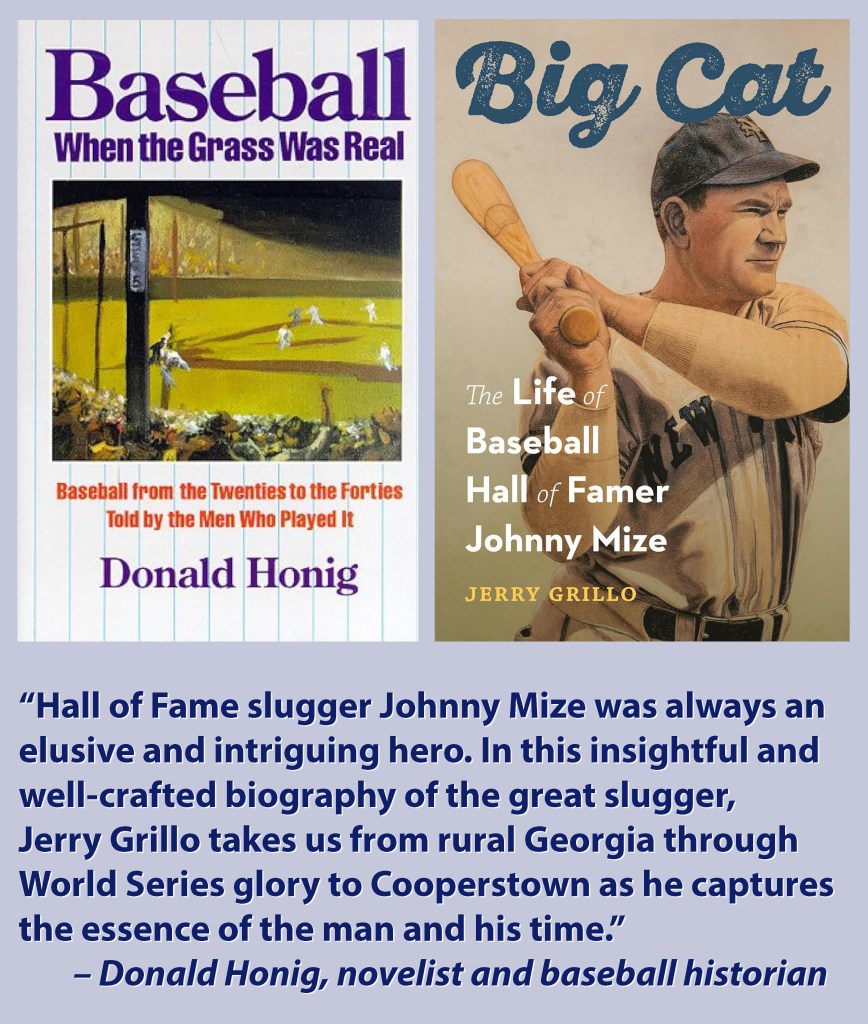
Honig, who loved the book, urged his friend Larry to write another, this time featuring ballplayers from a later era. Larry turned the tables and suggested Honig – a successful novelist and former minor league ballplayer – take on the project. So, in 1974, with a tape recorder, curiosity, and his love-of-the-game in tow, Don toured the country and gathered priceless stories from men who played the game in the 1920s, 30s, and 40s. Lefty Grove, Bob Feller, Pete Reiser, Cool Papa Bell. And Johnny Mize.
When I started the research on “Big Cat,” around the turn of the century, the best and most extensive thing written about Mize – except, possibly, for Mize’s own book, “How to Hit” – was the chapter in Don Honig’s book. It’s Mize’s voice! You can hear his quiet intelligence, his soft articulation, his succinct gruffness, and his sly humor.
“What I sensed in Mize was a deep pride and an unusually deep inner being,” the insightful Honig wrote to me in a September 2000 letter. “I don’t want to sound presumptuous about what was, after all, a ninety-minute conversation, but I felt he was a man who kept a tight hold on his emotions, who shrewdly took in what was said to him and measured his responses carefully.”
As I explain in the book, about a year later I put down the Mize project to focus more on family, following the birth of our surprise (and surprising) son, Joe. But when it was time to revisit Mize, the first person I contacted was Donald Honig. This time, we used the telephone.
I told him that one of the reasons for resuming work on the book was that I didn’t want to have wasted his time. He thanked me for that, and we talked a lot about the hold baseball has had on him, on me, on the people who care about this ridiculous game.
“When I was traveling the country, I’d be in some dingy motel in some little town, and find somewhere to go for a drink,” he said. “Inevitably, I’d meet someone, and we’d start talking baseball. Next thing you know, four guys are in on the conversation, talking like we’ve known each other forever, but we never met before and we’re not gonna see each other again. But we spend all night sitting and drinking and talking baseball together. It’s a great unifier.”
To stop at “Baseball When the Grass Was Real” is to do Honig, and yourself, a great disservice. Among his many other nonfiction baseball classics are “Baseball Between the Lines,” “The Man in the Dugout,” and his autobiographical “The Fifth Season.” But you should really check out his novels, including “The Ghost of Major Pryor” and “The Last Great Season.”
Also, you can find several of Don’s stories that have been turned into wonderful television episodes. On the original “Alfred Hitchcock Presents” check out his ‘Mrs. Herman and Mrs. Fenimore’ (1958) and ‘Man with a Problem’ (also 1958, a story he wrote as Donald Martin). Honig’s ‘Man on the Edge’ made for a great episode in the 1980s version of “Alfred Hitchcock Presents” and two of his stories were depicted on “Tales of the Unexpected” in the 1980s: ‘A Passing Opportunity’ and ‘Vicious Circle.’
He’s 93 and retired now. But Donald Honig’s stories, from his books and our conversations, are peppered throughout my book, “Big Cat.” You simply can’t write a decent book about Johnny Mize without seeking out Honig. I wanted to thank him for his permission and had another favor to ask. Would he write a blurb for my book?
I’m forever grateful that he was happy to. Of course, I sent him a printed manuscript – the only one I printed during this entire process. And after a few weeks, he called me back and gave me a beautiful endorsement, dictated over the phone. When the book is finally a printed thing (it’s official release is in April), I hope that Don Honig receives the first copy.
***
Oh yeah: Back in August 2000, when I first tried to contact Donald, I reached out to the University of Nebraska Press, which had re-released some Honig classics at the time. The Press passed along my interest to Don, who wrote me a letter, and we began our conversation. Fast forward to now: the University of Nebraska Press is publishing “Big Cat.”
You can get 40% off through the Press by using this promo code: 6AF23
Here’s the link: https://bit.ly/468WN7f
 JerryGrilloWriter.com