There are some great pitchers who, when I take the time to think about them, surprise me with what they haven’t done.
Like, how is it that Bob Feller didn’t win 300 games and strike out 3,000 batters? And how is it that Nolan Ryan or Juan Marichal never won a Cy Young Award? Rhetorical questions, obviously. Feller missed more than three seasons during World War II. Marichal played in the age of Koufax, Gibson, and Seaver. Ryan came close once, finishing second to 1973’s American League winner, Jim Palmer.
Speaking of which, Palmer also makes my “how is it” list. Like, how is it that Jim Palmer isn’t a 300-game winner? I have the same “how is that possible” question for Ferguson Jenkins, but Palmer is the card that I randomly plucked from the shoebox for this edition of Spirit of ’73, so that’s why we’re talking about him. More about that random pluck in a minute (it’s pretty weird, so stick around for a few more paragraphs if you’ve got nowhere else to be).
The reason it surprises me that Jim Palmer didn’t win 300 games is, year after year after year, he won 20 or more games, through the 1970s. He did it eight times in nine years – I looked it up. Therefore, 300 or more victories seemed like a lock (to my muddled mind) for the famously handsome (he was also a fashion model) right-hander.
The three or four of you who read this (thank you, sincerely) will probably also know Palmer as a great, insightful broadcaster. The guy is just polish all over. Even now, closing in on 80, he looks like he could pitch two or three innings of middle relief.
Anyway, Palmer’s career almost ended before it really got going. He had a terrific rookie season in 1966, won 15 games, then shutout the Dodgers, 6-0, beating Sandy Koufax in Game Two of the World Series, which the Orioles swept.
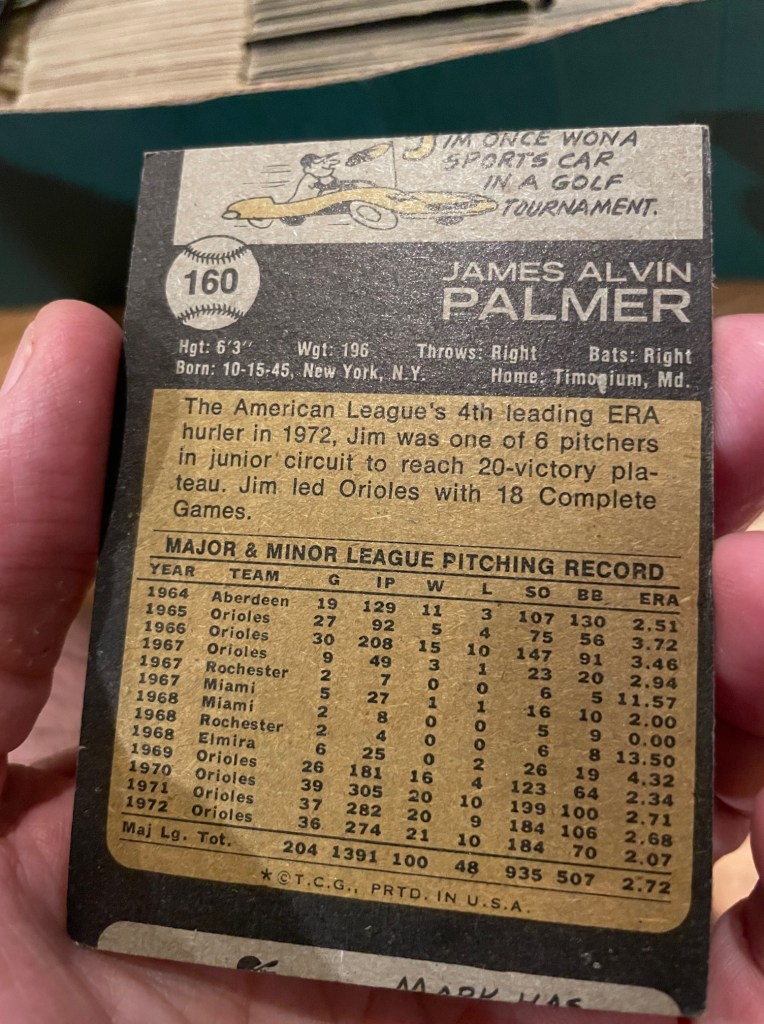
The next two seasons were almost the end for Palmer. His shoulder stiffened up and he was sent back to the minor leagues in ’67. Then he played for three different farm teams in 1968 and considered quitting.
But, as mysteriously as the injury started, it disappeared. He went 16-4 for the pennant winning 1969 Orioles, and became one of the best pitchers in the game over the next decade, which is stuff you probably know or could easily find out. But here’s the really weird thing about Palmer as this week’s Spirit of ’73.
Maybe I shouldn’t think of it as weird. Maybe it’s inevitable. Col. Bruce Hampton used to say 80 percent of his life was mythocracy and the other 20 percent was the really weird stuff. He was really onto something there. Sometimes it’s the little things, I guess.
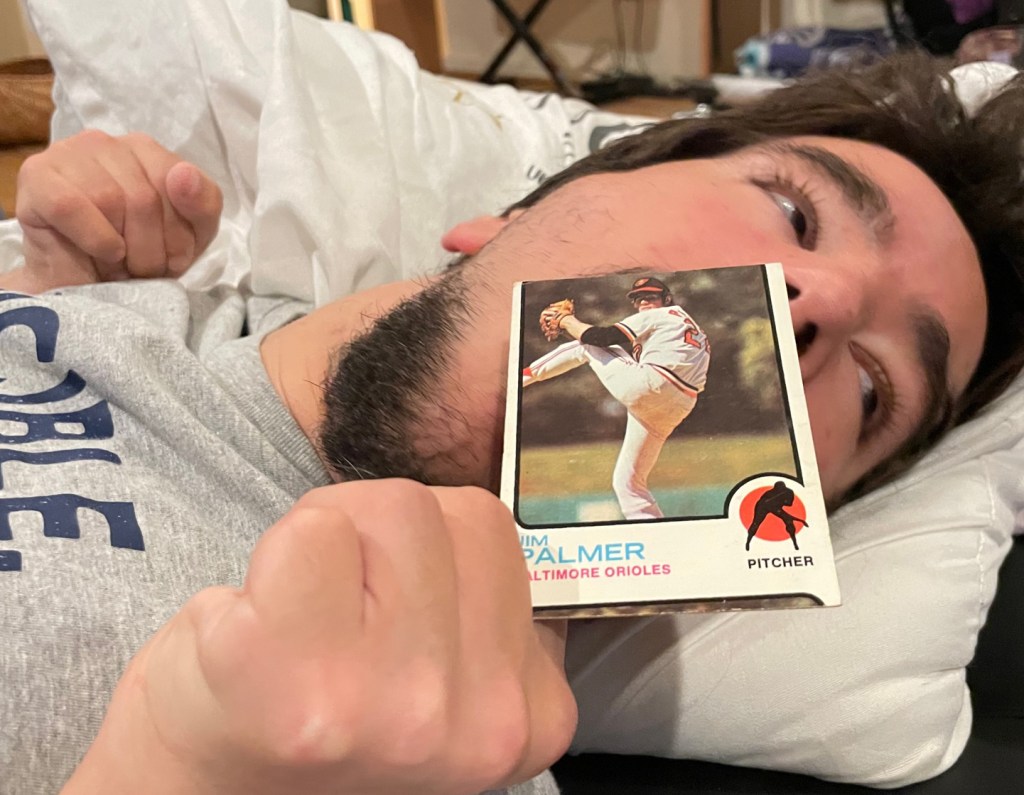
Anyway, for this essay on a random 1973 baseball card, I decided to pick the 22nd card, counting from the back of my stack. No reason, just thought, “I’ll pick the 22nd card from the back.” That card is the off-center Palmer you see my son holding in the first photo above.
Guess what Jim Palmer’s number was? Yep. The Baltimore Orioles retired his No. 22 almost 40 years ago. Oh yeah. And today happens to be Joe’s 22nd birthday.
So, there’s that.
***
Johnny Mize P.S.: Never known as a defensive superstar, the Big Cat nonetheless did have moments of brilliance at the first sack from time to time, actually leading the league in defensive statistics like range factor, fielding percentage, assists, and putouts for several seasons. Oddly enough, Mize may have received his best coaching as a first baseman from a big-league team that he never played an official game for. In the spring of 1935, Mize played for the Cincinnati Reds, who employed George “High Pockets” Kelly, a slick fielding first baseman for the old New York Giants, to coach the young Big Cat.
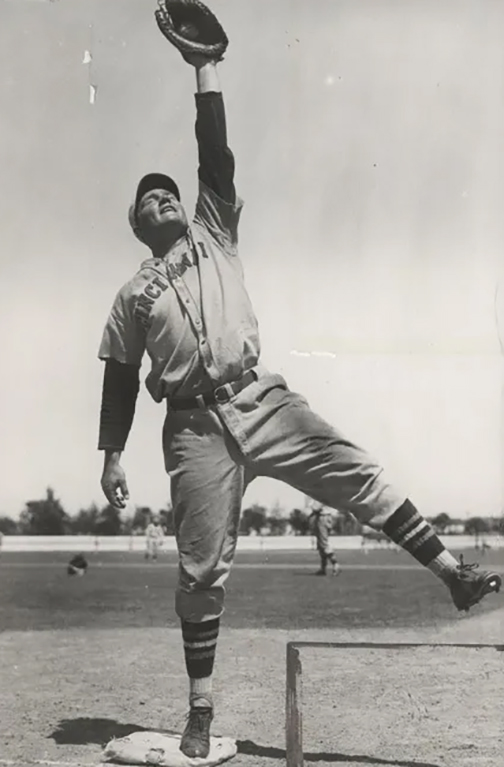
Though Mize hit like a big league superstar, he’d suffered an injury a year earlier, and the Reds returned him to the St. Louis Cardinals organization as damaged just before Opening Day. You can read all about this stuff and a lot more in my book, Big Cat: The Life of Baseball Hall of Fame Johnny Mize, coming out baseball season, from University of Nebraska Press.
 JerryGrilloWriter.com