In the top of the eighth inning of Game Four in the 1973 World Series, pinch hitter Mike Andrews led off for the Oakland Athletics, who were trailing the New York Mets, 6-1. The partisan Mets crowd in Shea Stadium, about 54,000 people, gave him a standing ovation, undoubtedly the first one he’d received since he was a member of the Impossible Dream Red Sox of 1967, his first full season in the big leagues.
A minute later, Andrews received the last standing ovation of his career after grounding out to third base and trotting off the field. None of these fans knew this was Andrews’ last appearance in the big leagues, and they probably wouldn’t have cared anyway. They weren’t cheering Andrews’ eight seasons as a decent second baseman, mostly with the Red Sox and White Sox. These were cheers of spite. The fans wanted to see smoke come out of Charlie Finley’s ears.
Here’s why. A few days earlier, in Game Two, Andrews made two errors in the top of the 12th inning, on two consecutive plays (although one was a bad hop, and the other error probably should have been given to first baseman Gene Tenace. Besides, wrote Saul Wisnia in his biography of Andrews for the Society of American Baseball Research, “Replays indicated the umpire missed the second call.” Nonetheless, the Mets went on to win the game, 10-7

Mike Andrews’ 1973 card is his last. He began the season with the White Sox, who released him in July. The Oakland A’s picked him up for infield insurance.
“Even before the game was over, meddling A’s owner Charlie Finley was on the phone with the team physician,” Wisnia wrote. Finley and the doctor cooked up a scheme that pressured Andrews to sign a document saying he had a shoulder injury and was going on the disabled list, removing him from Oakland’s roster for the Series. The rest of the A’s and their manager, Dick Williams, were furious with Finley. The players wore Andrews’ number 17, written in athletic tape, on their uniforms, and Williams was so pissed off that he quit following the World Series.
After Andrews came forward and admitted he was forced to sign the document, baseball Commissioner Bowie Kuhn reversed Finley’s overreaction and ordered that Andrews be reinstated for Game Four. The Mets dominated the game as Rusty Staub bashed a home run and had four hits and five runs batted in, and lefty Jon Matlack held the A’s to five hits.
With relief pitcher Horatio Piña due up to start the eighth, Williams called on Andrews to pinch hit. And the Mets fans greeted him with the aforementioned ovation, partly out of sympathy for the beleaguered Andrews, but mainly as spite for Finley, their cheers falling like acid rain on the grim-faced Oakland owner. The stadium erupted in another ovation after Andrews’ grounded to Mets third baseman Wayne Garrett, who threw to Jon Milner for the out. Not a bad way to end a career – leaving the field after grounding out as fans in enemy territory rise to their feet and cheer.
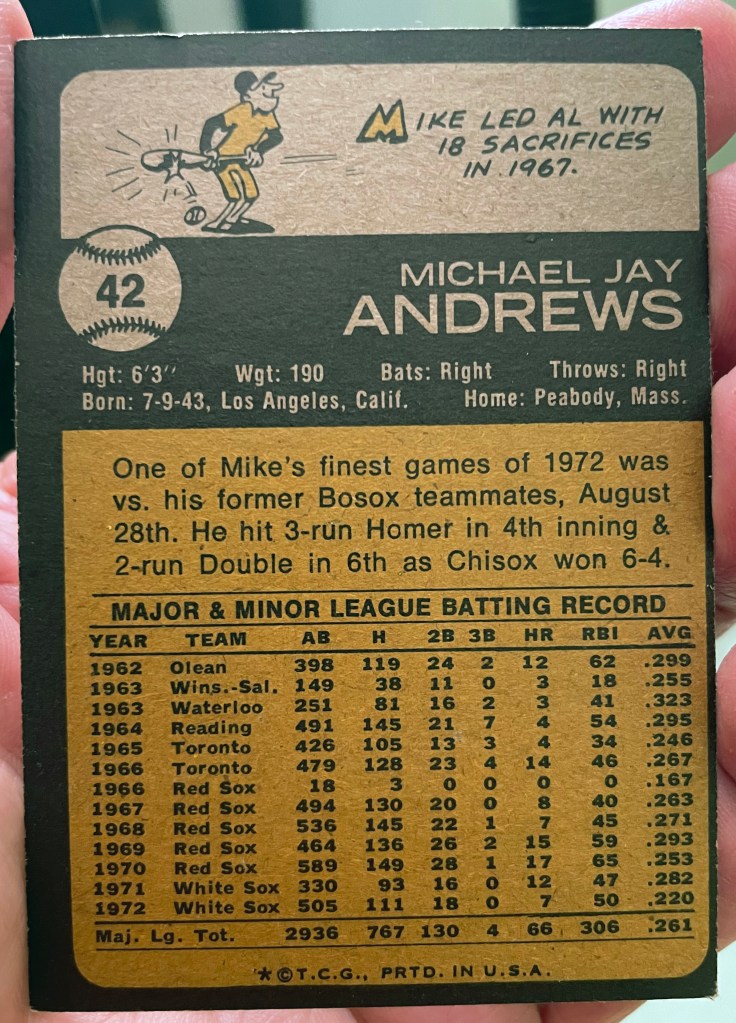
Andrews was a second baseman built like a split end (at 6-3, 195, he was offered a scholarship to play football at UCLA). He hit with some power, had more walks than strikeouts, fielded his position well most of the time, but also led the league in errors three times. Still, he was a bona fide big leaguer. After he left the A’s, he played a season in Japan before moving on to the job he was meant for: Chairman of the Jimmy Fund of the Dana-Farber Cancer Institute in Boston. He spent decades raising hundreds of millions of dollars for childhood cancer research and treatment, retiring from that job in 2010.
“As I’ve said, playing 13 years of professional baseball, two World Series, an All-Star Game, and being part of the ’67 Red Sox, it doesn’t really compare to the 31 years I spent at Dana Farber with the Jimmy Fund,” Andrews told a reporter a few years after his retirement.
He should have received another standing ovation.
For more on Mike Andrews, check out his SABR biography, written by Saul Wisnia, and also take a look this great story by Thomas J. Brown, Jr., about Game Four of the 1973 World Series. I’d forgotten what a piece of work Charlie Finley was!
******
Johnny Mize P.S.: A sad anniversary came and went on June 2, 2023. That was the 30th anniversary of Johnny Mize’s death. He watched a Braves game that night in 1993, went to bed, and never woke up. Read all about the life and times of this remarkable man from the mountains of Northeast Georgia in the upcoming Big Cat: The Life of Baseball Hall of Famer Johnny Mize, from University of Nebraska Press in spring 2024.
 JerryGrilloWriter.com