So, this is an ongoing experiment. Maybe it’s more accurate to say this is an experiment in ongoingness. I have a few shoeboxes of baseball cards remaining, and about a year until the release of my book about Johnny Mize, Big Cat: The Life of Baseball Hall of Famer Johnny Mize. Anyway, here’s the idea: I’ve 302 cards from the 1973 Topps set. I’m going to pick a random player from the box and share his story in each of these installments. Also, I’ll share a little Mize postscript.
Why 1973? Well, partly because it’s 50 years ago and that’s a nice, round number. Partly because I’ve got a lot of cards from that year. Also, it was a momentous year in baseball (kind of like most years, if I’m being honest). The designated hitter was introduced that year. The Mets made an amazing run from last place to the National League pennant in the final month of the season.
Speaking of the Mets, it was Willie Mays’ last year as a player. And for this 12-year-old kid who turned 13 just before the World Series, it was a great year to be a Braves fan, as three of my local heroes belted 40 or more home runs. Who knows, I might pull one of their cards from the stack — but if I do, it’ll be completely arbitrary. I’m just as likely to pull Expos relief pitcher John Strohmayer, or Cleveland shortstop Jack Heidemann.
So, let’s get right to it. Picking now … oh, cool! It’s Dave Kingman!

He was nicknamed King Kong and Sky King, because of the tape-measure home runs he used to hit. He once sent a 530-foot missile out of Wrigley Field in a ridiculous game in 1979 (his best year), when he hit three homers for the Cubs, but the Phillies still won, 23-22.
But this card.
This card always made me laugh, because the angle of the bat makes it look one of those little toy bats. Then again, Kingman was 6-6, so any bat looked small in his hands.
As I mentioned earlier, Dave had a talent for hitting home runs. He hit 442 of them in his career, a big number. But that was all he did. Early in his career, he was fast for a big guy, as the back of his 1973 baseball card says (in 1972, his breakout year, he stole 16 bases). His on-base average was pretty awful for a slugger — he struck out a ton and rarely walked, and his batting average crept below his weight on several occasions.
Dave was a complicated guy. He moved around a lot — seven different teams in his 16 years, including two different stints with the New York Mets. He never seemed very happy, and he had a talent for making other people unhappy with him (he was traded three times one season).
He had a terrible relationship with the press, and for good reason. He hated the press. He dumped a bucket of ice water on a Chicago sports writer, and after being a real schmuck to a female sports writer in California, he sent her a rat in the mail for good measure. “It’s an insult to be called a writer,” he said, at a time when he was writing a regular column for the Chicago Tribune.
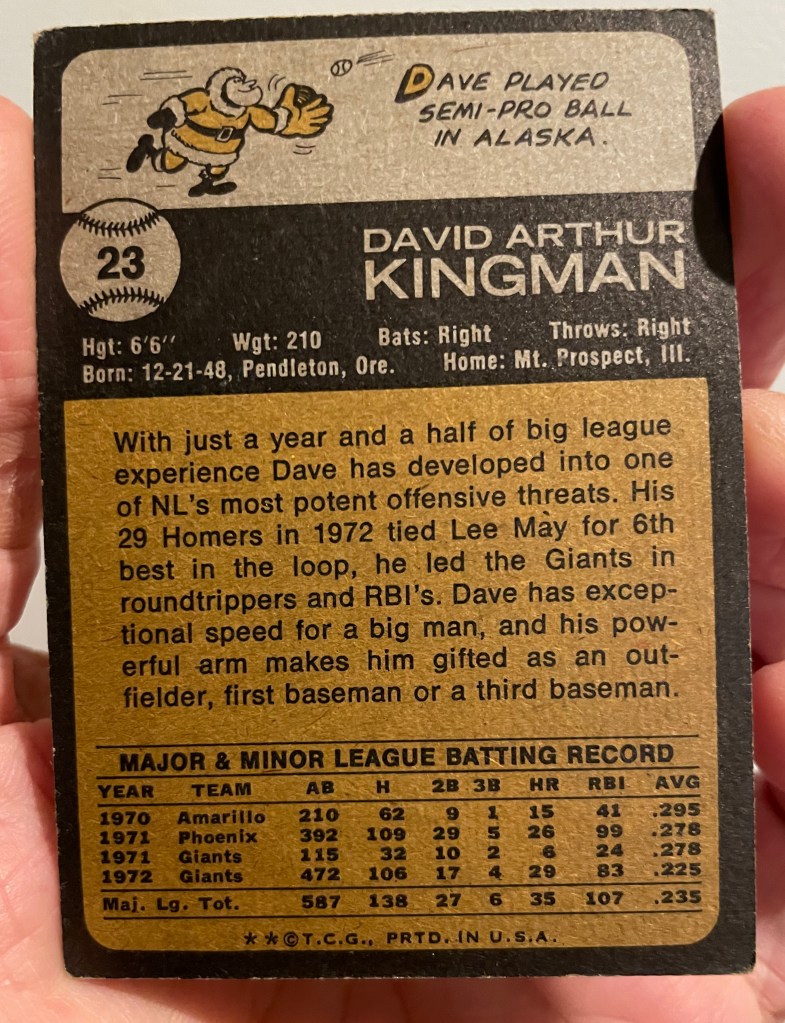
Anyway, for a guy who struck out three times as often as he walked (and whose strikeouts outnumber his base hits), Kingman carved out a long career for himself. His home runs were legendary and he went out with a flourish, setting a record (since broken by David Ortiz) for most home runs by a player in his final season. He hit 35 for Oakland in 1986, then quit. For more about the Sky King, check out this great story from Joe Posnanski. It’s 15-years-old, but still a great read.
******
P.S. Another thing about 1973. That was the last year Johnny Mize appeared on the writer’s ballot for the National Baseball Hall of Fame. He didn’t make the cut. But eight years later he made it into baseball Valhalla through the veteran’s committee.
 JerryGrilloWriter.com